/
Capturing an Assets Initial Charge
Capturing an Assets Initial Charge
- Joseph Yarborough (Unlicensed)
- Anastasia Troichuk (Unlicensed)
Owned by Joseph Yarborough (Unlicensed)
Adding the First Asset Charge
The asset initial charge should be captured when you are creating the asset in Asset Manager.
⦿ How to Capture an Assets Initial Charge
- Navigate to the Assets (Equipment) module > Manage Assets. The list of assets opens.
- Click the Add button in the upper-right corner.
- Start creating a new asset by filling out the required fields.
- Complete the Initial Charge Info section.
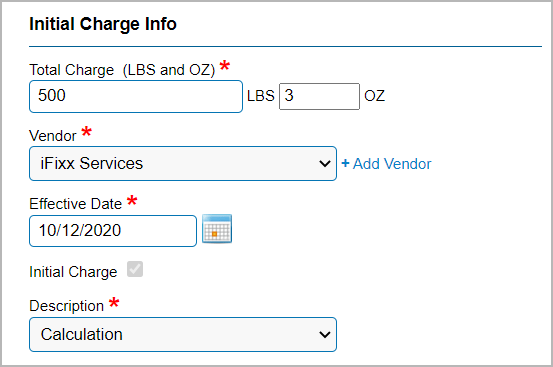
- Total Charge: Enter the current amount of the refrigerant gas contained in the asset in pounds and ounces or in kilograms and grams — depending on the way the settings are configured for you.
- Vendor: Select the provider who identified the initial charge of the system. If the required provider isn’t on the list, click + Add Vendor, and add the provider manually.
Effective Date: Pick the date when the initial charge was done.
The Effective Date of the initial charge cannot be in the future.
- Initial Charge: This checkbox is selected by default denoting that the total charge you entered earlier will be considered the asset initial charge amount.
- Description: Method of how the initial charge was taken.
Viewing the Asset Initial Charge
⦿ How to View an Assets Initial Charge
- Navigate to the Assets (Equipment) module > Manage Assets. You land on the assets list.
- Click the asset tag ID to navigate to the asset detailed view.
- Switch to the Refrigeration Details tab.
- Scroll down to the Current Charge section. If no additional charges have been added to the system and the Initial Charge box is checked, the quantity you see above the Total Charge is the asset's initial charge.

Adding Follow-Up Charges
Over time, you might need to add a new charge to your asset.
Please note that while an asset has an open leak record, no new charges can be added to the asset.
⦿ How to Add a Follow-Up Charge
- Navigate to the Assets (Equipment) module > Manage Assets. You land on the assets list.
- Click the asset tag ID to navigate to the asset detailed view.
- Switch to the Refrigeration Details tab.
- Scroll down to the Current Charge section.
- Click Add Charge.
6. Enter the required information, and then click Save.

In this Article

Related Articles
, multiple selections available,
Related content
Refrigeration Work Orders in ServiceChannel Provider
Refrigeration Work Orders in ServiceChannel Provider
More like this
Refrigerated Asset Charge History
Refrigerated Asset Charge History
More like this
Charge History Report
Charge History Report
More like this
Adding and Editing Assets
Adding and Editing Assets
Read with this
Creating Refrigerated Assets
Creating Refrigerated Assets
More like this
Refrigerant Tracking Manager
Refrigerant Tracking Manager
Read with this