Viewing the Work Order Details Page
- Joseph Yarborough (Unlicensed)
- Caroline Antoun
- Natalia Larina (Unlicensed)
The detailed view of a work order is comprehensive, as it lets you manage the work order with more detail. Specifically, you can:
View all key details regarding a work order, such as tracking number, caller details, problem description, and location information (for example, address and contact information of the location to which the work order is attached).
Reschedule the work order, update the status, add notes and attachments, and view status changes and notes/attachments added by other users including any pinned notes from your client indicating this is the most import/pressing note right now for this work order.
On the Work Orders page, locate the desired work order, and click View. A detailed view of the work order displays.

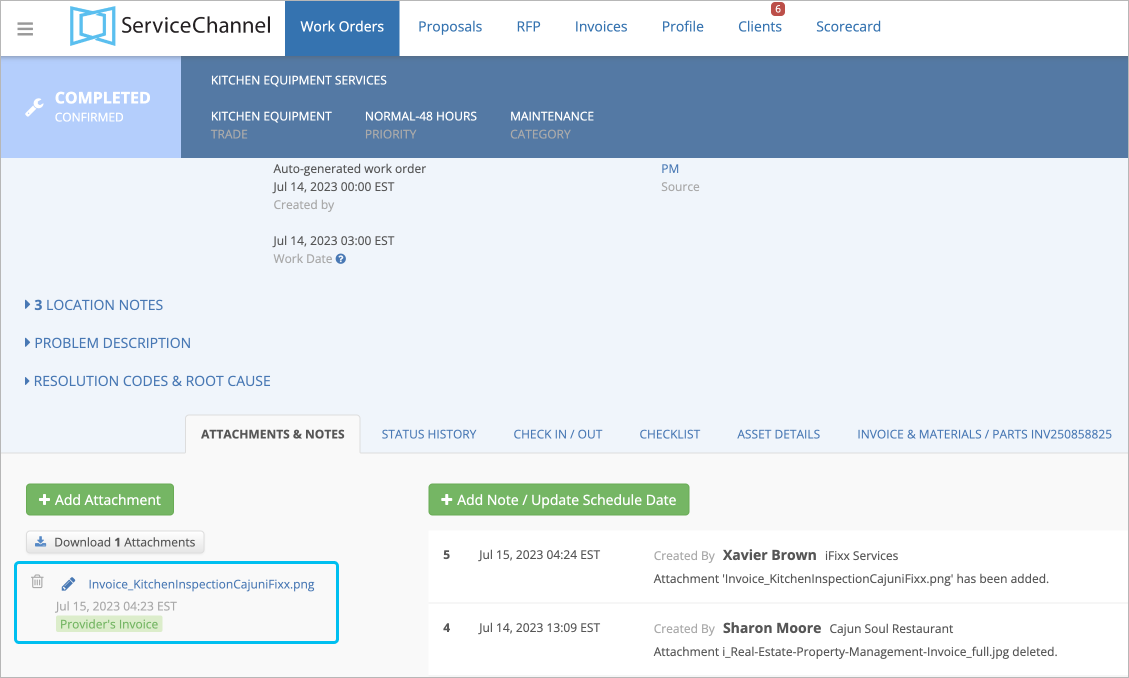
The top portion of the window displays the details and description about the work order, while the bottom portion displays the work order activity, such as status changes and notes, and lets you take actions on the work order, such as rescheduling and adding notes or attachments.
Work Order Details and Description
The details and description display in four groups:
Work Order Status and Summary

The work order status and summary appear in the header of the detailed view.
The left section of the header displays the current status and extended status of the work order, and is color-coded based on the status. Read About Work Order Statuses for more information on statuses.
The right section of the header displays the problem details: the first row displays problem code; the second row displays the area, problem type, and asset; and the third row displays the trade, priority, and category of the work order. In case the problem code, area, problem type, and asset details are not available for a work order, the problem description displays.
Work Order Details
This section displays work order identification details in four columns.

Section | Details Available |
First column |
|
Second column |
|
Third column |
|
Fourth column |
|
Location Notes
In this section, you may view information the client has added about the location to which the selected work order is attached, such as store details and contact information.
Problem Description
This section displays the area, problem type, asset, problem code, and description. For completed work orders, the work summary and invoice text also appear here.
Resolution Codes and Root Cause
This section contains the resolution and root cause codes added via either ServiceChannel Provider or Provider Automation for completed work orders.
Viewing Work Order Activity and Updating the Work Order
The bottom section of the work order window displays all of the work order activity in four tabs: Attachments & Notes, Status History, Check In/Out, and Invoice & Materials/Parts.
Attachments & Notes Tab
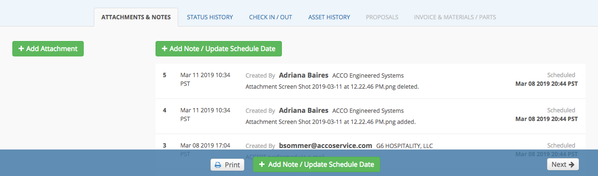
This tab displays the history of all activity pertaining to the work order, such as system-generated notes, notes and attachments added by users, any rescheduled information, and change of statuses, along with the date, time, and the name of the user who made the change. You may also add an attachment or a note, reschedule the work order, or update the status from this section. Work orders with a Checklist that includes attachments also appears under the tab.
Notes and Attachments - When adding a note, you may place an Action Required flag to alert the recipient to take further action on the work order. You may either select a recipient(s) with access to the specific location from the To Send Email Select Addressees list or enter an email address(es) in the or Enter Email Address(es) box. You may also add attachments related to the work order in order to aid in the resolution of the issue. You may also add notes/attachments to a work order through email.
Rescheduling the work order - There may be instances where you want to reschedule a work order, such as when you cannot make the original scheduled date, or if there is inclement weather on the original scheduled date.
Updating the status- You may change the status to reflect the work order progress. Some examples of when you may change the status are: once the work order is complete, you may mark it as Completed/Pending Confirmation; or, in case a provider has a problem with checking in, you may update the work order status to In Progress.
You can attach digital copies of the provider’s original invoice. Contact your ServiceChannel manager to mark attachments as digital invoice copies.
Status History Tab
The Status History tab displays the history of all status changes made including the updated status, provider assignment, reassign reason, the user who updated the status, and the date and time the status was updated.

Check In/Out Tab
Check-in or check-out made through either the GPS mobile app or the IVR telephone system and the details of the labor performed appear here. Check in/out details available include:
The date and time of each check-in and check-out
Your User ID
The Caller ID used to check in/check out
Whether it was a check-in or check-out
The status indicated at the time of check-in or check-out
Work type
Number of hours spent on-site
Please, contact your ServiceChannel representative should you need to change the decimal point (.) to decimal comma (,) on non-monetary amounts, such as:
- Hours and Duration
- Quantity Amounts
- Weight.

The information listed under Caller ID will differ, depending on the system used:
IVR check in/check out: The phone number used to dial in appears.
GPS check in/check out: The geolocation coordinates of the user’s mobile phone appear.
When a technician checks in, he or she may also enter the total number of technicians working on the problem, which is indicated in the Labor section. The details displayed in the Labor section are:
Name
Work date
Time in
Time out
Number of technicians
Regular hours
Premium hours
Invoice and Material/Parts Tab
In case you added an invoice, you may view it in this tab. The invoice number appears in the name of the tab. This tab has two sections: Client Rates and Materials.
Client Rates displays the details of the labor rates, travel expenses, and materials cost added through the invoice. The caller name and the date the invoice was created are also listed here.
Materials Ordered lists supplies ordered through the Supply Manager platform, including the quantity, part number, description of the part, and price points.
Printing Work Order Details
You may print the work order details from the detailed view.
- In the detailed view of a work order, click the Print button at the bottom of the page.